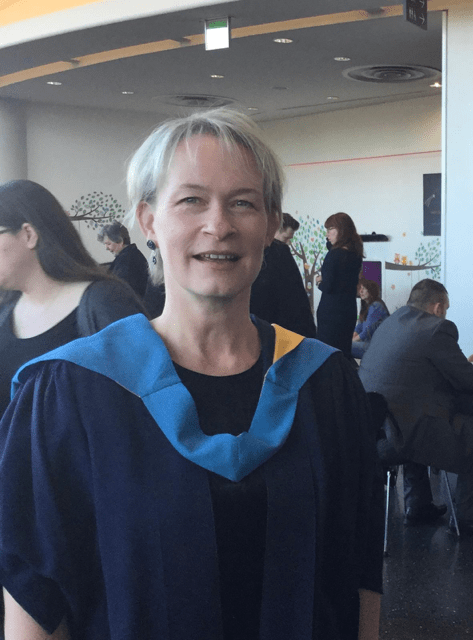
Lesley
1. What learning did you undertake?
In my 40s, I had a good job, a family, and young children, but I still felt like something was missing. One day, I saw an ad for the Open University’s free online short courses ‘OpenLearn’ and decided to try one or two in history, which is a subject I’d become interested in following a job I’d had a few years previous. Each time I completed a course, I received a certificate. That small sense of achievement spurred me on to try a 3- month course with the Open University that worked towards an actual qualification – and that was exciting. I continued one year at a time. I kept telling myself, “I’ll just try this one. If I can’t do it, it’s not much lost, but at least I’ll have given it a go.”
Even with limited time, I found myself studying in the early hours, often in the dark, scribbling away. It wasn’t always easy, but I discovered that if you’re genuinely interested in something, you find the time, and you keep trying.
Eventually, I earned my degree in History, studying part-time over six years. The sense of achievement was incredible. My confidence grew, and I felt immensely satisfied, with no intention of doing more. But when the kids left home, I found myself with a bit more time. I started exploring different topics through OpenLearn, and even considered starting a degree in a completely different subject. However, it was history that kept drawing me back. The idea of pursuing a master’s degree seemed daunting and out of reach, but it wouldn’t leave my mind. So, impulsively, I signed up. Again, I thought, “If I can’t do it, at least I’ve tried.”
The course connected me with the place I live, sparking an interest in the land, sea, and local history. This led me to want to experience the things that were important to the people I studied. I learned coastal rowing, spent more time walking and running outdoors, and felt a deeper connection to my surroundings.
In total, from the time I started that very first course, to earning my MA in History, it has taken about 12 years, but that has suited my lifestyle. I never felt pressured to rush, and I was able to enjoy the learning process at my own pace.
2. What were the benefits of the learning experience?
I discovered a lot about myself. I became more confident and met people with similar interests. It was fun and it gave me a sense of purpose. Focussing on my studies also helped me take my mind off things I might otherwise worry about, and it opened my mind to different ways of thinking.
3. What would you like to learn next?
I’d like to learn how to build a website so I can share the local history I’ve researched. I also want to pick up where I left off with art history. I’d like to try sea kayaking—if I don’t like it, I don’t have to do it again, but at least I’ve given it a go. You never know until you try.
4. Any ‘top tips’ for others?
If you feel a spark of interest in something, just give it a go. You never know where it may lead.
 Lifelong Learning Hub (Skye and Lochalsh)