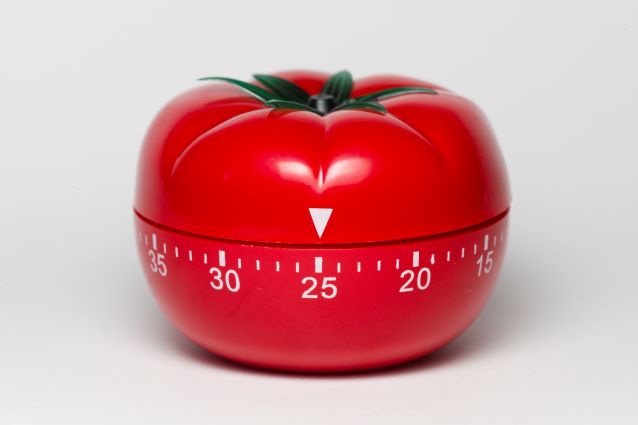
The Pomodoro Technique
(stop procrastination and improve focus)
The following information has been copied from the Todoist website: Link
The Pomodoro Technique was developed in the late 1980s by then-university student Francesco Cirillo. Cirillo was struggling to focus. Feeling overwhelmed, he asked himself to commit to just 10 minutes of focused study time. Encouraged by the challenge, he found a tomato (pomodoro in Italian) kitchen timer, and the Pomodoro technique was born.
- Get a to-do list and a timer.
- Set your timer for 25 minutes, and focus on a single task until the timer rings.
- When your session ends, mark off one pomodoro and record what you completed.
- Then enjoy a five-minute break.
- After four pomodoros, take a longer, more restorative 15-30 minute break.
The 25-minute work sprints are the core of the method, but a Pomodoro practice also includes three rules for getting the most out of each interval:
- Break down complex projects. If a task requires more than four pomodoros, it needs to be divided into smaller, actionable steps. Sticking to this rule will help ensure you make clear progress on your projects.
- Small tasks go together. Any tasks that will take less than one Pomodoro should be combined with other simple tasks. For example, “write rent check,” “set vet appointment,” and “read Pomodoro article” could go together in one session.
- Once a pomodoro is set, it must ring. The pomodoro is an indivisible unit of time and can not be broken, especially not to check incoming emails, team chats, or text messages. Any ideas, tasks, or requests that come up should be noted to return to later. A digital task manager like Todoist is a great place for these, but pen and paper will do, too.
In the event of an unavoidable disruption, take your five-minute break and start again. Cirillo recommends that you track interruptions (internal or external) as they occur and reflect on how to avoid them in your next session.
 Lifelong Learning Hub (Skye and Lochalsh)